The difference between an angel investor and a venture capitalist goes beyond the amount of money they invest; it comes down to how they are motivated to use their money.
How does angel investment differ from venture capital? An angel investor is an individual who invests their personal money in young businesses. These investors invest less money than venture capitalists, and they are usually less involved in business management.
On the other hand, venture capitalists are usually companies that have large amounts of money from different investors. They are also known for their greater involvement in business management, as they sometimes serve on the boards of directors of the companies they invest in.
Now that you know the difference between an angel investor vs a venture capitalist, which one should you seek out for your business?
It really depends on your needs and goals. If you're looking for quick growth and don't mind giving up some control over your company, then VC might be right for you. But if you want more flexible terms and less interference with how you run things, then an angel investor might be a better bet.
This article, based on my decade-long experience in seed investment and entrepreneurship education, demonstrates the practical differences between an angel investor and a VC beyond theoretical considerations.

What is an Angel Investor?
An angel investor is a person who provides money to fund a start-up company or an entrepreneur. An angel investor uses their own money and usually invests in a startup through equity or convertible notes.
Modern-day angels are either accredited, wealthy individuals or experienced entrepreneurs, but in some cases, they can even be friends and relatives of the entrepreneur. However, because they are not professional investors, they may not have the same level of experience or expertise.
However, one point has been ignored in the definition above: angels need not be limited to the first stage. Angels in the current environment can move further than that through secondary deals, syndicates, and Special Purpose Vehicles (SPVs). While not very common, solo angels with relatively little money can still participate in firms like Anthropic or SpaceX, demonstrating the scope available today.
One potential drawback is the lack of LP accountability, which can harm angels. A recurring theme in my experience is that angels overestimate their contribution and influence, a tendency that is sometimes disproportionate to the size of the check they can write. A $25,000 check does not provide sufficient grounds for any operational interference.
Another issue here relates to exits. Acquiring funding for a company might be easy. However, making a profit from it or obtaining a return on the investment requires completely different skills.
Venture capitalists, on the other hand, are professional investors who invest other people's money in exchange for equity in the company. Venture capitalists are typically more hands-on than angel investors and may provide funding only after the company has reached a certain level of growth.
What is a Venture Capitalist?
A venture capitalist is an investor who provides capital to companies in exchange for equity. Venture capitalists typically invest in early-stage companies, providing seed money to help them get started. In return, the venture capitalist gets a stake in the company.
The structural pressures faced by the venture capital (VC) fund are not mentioned when discussing founder-centered topics or their effects on the startups it funds. According to the NVCA 2024 Yearbook, VCs invested over $170 billion in deals made in the United States in 2023 alone. A typical VC fund has a ten-year term, during which it must invest capital, help its portfolio companies grow, and return profits to limited partners (LPs) in multiple rounds so the fund can justify its existence and raise another, larger fund. Each time a VC makes an investment decision, the question remains whether it matches the VC's timelines.
That way, the selection process will be biased towards certain types of startups. A perfectly good startup, but one that takes its time to develop, is unlikely to meet the needs of a VC fund because it does not fit within the required timelines.
Venture capitalists are often thought of as high-risk, high-reward investors. A more appropriate definition for such an approach would be risk-adjusted, meaning that they take calculated risks based on the needs of their funds’ timelines, not out of foolishness. In fact, numerous venture-capital-backed businesses have achieved great success, including Google, Facebook, and Amazon. However, it's important to remember that not all venture-backed companies succeed. For every Google or Facebook, many more companies fail.
What is the Difference Between an Angel Investor vs Venture Capitalist?
When it comes to early-stage investing, there are two main types of investors: angel investors and venture capitalists. Both play important roles in funding startups, but there are key differences between the two.
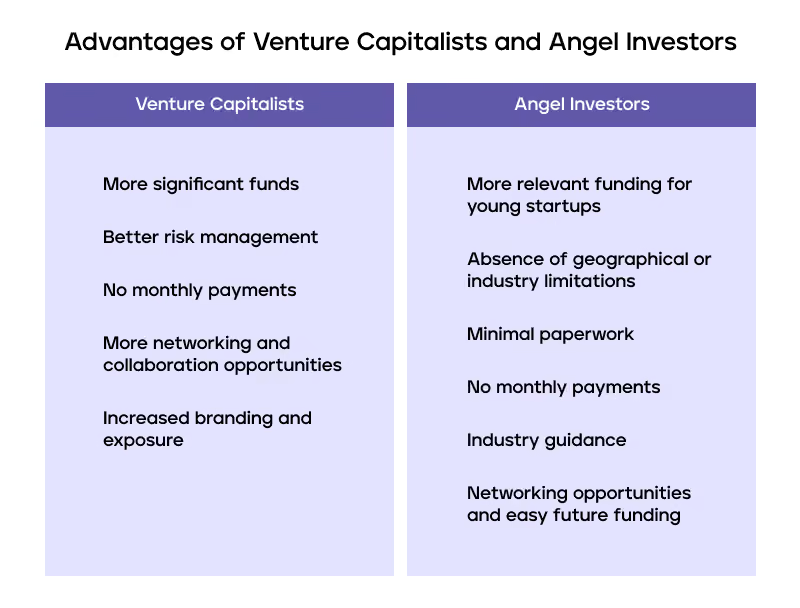
Angel investors are typically wealthy individuals who invest their own money in startups. They typically invest smaller sums of money than venture capitalists and often lack professional investing experience. Angel investors are often more willing to take risks on early-stage companies than venture capitalists, as they are often more motivated by the potential for high returns.
Venture capitalists are professional investors who use other people's money to fund startups. They typically invest larger sums of money than angel investors and have extensive experience in the investing world. It is often stated that venture capitalists are considered less risk-taking than angels; in fact, it would be more accurate to say that they are calibrated to risk. As they use other people’s money and their business model lasts about 10 years, they select enterprises with the potential to grow rapidly enough to repay the invested funds within that period.
(Source)
Real-World Examples: When Founders Chose Angel Investor vs VC
Not all founders with venture capital available decide to go down that route. And there are important reasons behind this decision.
Perhaps one of the most popular examples is Mailchimp. This company was bootstrapped and raised angel funding before being acquired by Intuit for $12 billion, without any venture backing whatsoever. In other words, the founders remained fully in control, deciding when to exit the business, not the venture fund.
Canva took another path. This company first secured angel funding and then went to venture capital after gaining validation and experience. Having angels gave founders enough time to validate the product without any pressure of scaling that comes with venture funds. Only after this did Sequoia get involved, and Canva was already far along.
The idea in both cases is simple. Angel funding provides more time, while venture funding forces you to move much faster, but only on the fund's terms.
From my experience at Angel School, the founders who get the most out of the angel stage treat it like a conscious choice, and not as a backup plan if they cannot raise money at a Series A round. Angels help founders reach important milestones that give them the right leverage at the next stage – be it angel syndicates or a Series A round.
It is not about which way is better. It is about which direction is better for your company at its current stage.
Angel Investor vs Venture Capitalist: Comparison Table
Why Do Companies Seek Out Angel Investors or Venture Capitalists?
When a company is first starting, it usually doesn't have much money. They may have a great product or service, but to get it off the ground, they need funding to cover costs such as inventory, marketing, and employee salaries.
This is where angel investors and venture capitalists come in.
Angel investors are usually wealthy individuals who are willing to invest their own money in a company in exchange for a small ownership stake. Venture capitalists are firms that invest money in companies in exchange for a larger ownership stake.
Companies seek out angel investors and venture capitalists because they need capital to grow. Without funding from these investors, many companies would not be able to get off the ground.
How to Pitch to an Angel Investor
If you're looking to raise money for your startup, you'll need to know how to pitch to an Angel investor. But what exactly is an Angel investor, and how do they differ from venture capitalists?
Here's a quick rundown: Angel investors are typically wealthy individuals who invest their own money in startups, usually in exchange for equity. They typically invest smaller sums than venture capitalists and are often more interested in the founder's vision and the team than in the immediate profit potential.
If you're looking to pitch an angel investor, you'll need to focus on what makes your team a winning gamble. Be sure to present key business factors such as your market size, product or service offerings, competitors and their flaws, and, if applicable, your current sales. Please make sure you bring your round structure with you, whether you're fundraising through a SAFE or a convertible note, along with your valuation cap. Experienced angels will ask about such details, and entrepreneurs who don’t know how to answer these questions show that they haven’t done their homework properly.
Most importantly, make your pitch relatable and memorable so that the angel investor remembers you and your startup when it comes time to write a check.
How to Pitch to a Venture Capitalist
Are you an entrepreneur looking for funding? Then you'll need to know how to pitch to a venture capitalist.
First, you need to understand what they're looking for. Venture capitalists are looking to invest in companies with the potential to grow quickly and generate significant revenue. They're also looking for companies led by experienced and passionate entrepreneurs. Since there is a time constraint on the life cycle of any fund, venture capitalists tend to focus on businesses that can grow fast enough to deliver returns within 10 years. Get ready to demonstrate your business's growth rate and CAC/LTV ratio, along with a plan to reach the next milestone.
When pitching to a venture capitalist, you'll need a well-thought-out business plan and a strong presentation. You'll also need to be able to answer any questions they have about your business.
If you're able to do all of this, then you'll be well on your way to getting the funding you need to grow your business.
Common Mistakes Founders Make When Approaching Each Investor Type
With Angel Investors:
Proceed with proper formality: Since angels are people and can also be reached through networks, entrepreneurs may sometimes not prepare properly. Although some angels can also write checks themselves, the best angels are those who set strict criteria for themselves. Prepare as you would for venture capitalists' meetings.
Be selective in receiving funds from a few angels only in the beginning: If the cap table comprises fifteen angels and there is no lead angel, it could spell trouble for future rounds involving venture capitalists. Venture capitalists look for a clean cap table and a single point person. Be selective with angels regarding both the number and the terms of the deal.
Assuming activity comes with the funding: Some angels like to be active, while others prefer not to be. This needs to be sorted out before any deal is done.
With Venture Capitalists:
Premature approach: The biggest mistake people make when dealing with venture capital firms is pitching their idea before it has traction. Vision alone without proof of the market rarely cuts it. Review the milestones each fund needs before contacting them.
Taking interest as commitment: Venture capital firms are always polite. No matter how many meetings you have had or signals you got, the VC firm does not necessarily have to write a term sheet. Continue with your processes.
Failure to understand the fund’s stage: If a fund is in its eighth year out of a ten-year life cycle, it means that the firm is in the harvest phase. It’s better to know in advance in order not to waste precious weeks.
How Can I Become an Angel Investor or Venture Capitalist?
Becoming an angel investor or venture capitalist can be a great way to make a return on investment while supporting small businesses and entrepreneurs.
But how do you get started?
Here are a few tips.
1. Do Your Research:
Before you invest any money, it's important to do your homework and understand the risks involved. Make sure that you are aware of the difference between angel investors vs venture capitalists. Perform adequate research on the investment opportunities being considered. According to SEC-accredited investor requirements, the first requirement for being an eligible investor is accreditation, but being accredited does not make you an expert investor per se.
2. Consider Your Financial Goals:
What are you looking to achieve by investing? Are you hoping to make a quick profit, or are you more interested in supporting a small business or entrepreneur over the long term? Furthermore, always plan an exit strategy at the beginning. According to research by the Angel Capital Association, most returns come from a few outlier exits. This shows that raising money is not difficult; rather, exiting is difficult.
3. Consider the Time Commitment:
Angel investing and venture capitalism can be time-consuming. Be prepared to commit the necessary time to due diligence and research before making any investments. Go beyond your local ecosystem when reaching out—the best deal flow isn't found solely through your network. Go for syndicates, angel networks, and online platforms that will expose you to new possibilities.
4. Work with a Trusted Advisor:
If you are a novice investor, seeking assistance from a financial advisor could prove helpful during this endeavor.
5. Diversify Your Portfolio:
Just like any other form of investment, having a diversified portfolio is crucial for reducing risk. You can allocate your investment across different firms and sectors, thereby reducing your risk. Syndication and SPV structures could allow one to invest in firms that operate in Series A or later funding rounds, not just pre-seed ventures.
6. Detach Ego from Decisions:
One of the most frequent failures in beginner angel investments is that they make their decisions through emotions and feelings. Make sure your investment due diligence evaluates the company's worth, not personal feelings about the business. The investor's value is determined clinically rather than through personal involvement.
The steps involved in becoming an angel investor or venture capitalist can be demanding. Nonetheless, if properly researched and planned, it is an interesting way of helping entrepreneurs earn money at the same time.
Understanding the Broader Landscape: Angel Investors vs Venture Capital
When comparing angels and venture capitalists, there is far more to consider than just money. Often, the distinctions lie in terms of motivation, the extent of participation, and timing. Angels usually get involved in a startup at its inception, at the concept stage, because they believe in the entrepreneur's vision and often hesitate not to mentor and offer advice.
In contrast, venture capitalists usually step in once the business has achieved some traction. The angel investor vs venture capital approach also differs in structure — angel investors use personal funds and make independent decisions, while venture capital involves institutional money managed through a firm. In essence, the venture capitalist cannot only be answerable to his limited partners; he functions for a period of ten years for the fund’s operation, and this determines the selection of the companies, the rate at which they are supposed to grow, and the period after which capital is supposed to flow back. In such a case, the comparison of angel investors vs venture capitalists becomes one of two different incentive structures, not just different checks.
The angel vs venture capital distinction becomes clear to entrepreneurs because, apart from understanding the different sources of funding they can consider, they also have an idea of the kind of business relationship they need to form. In cases where initial commitment and adaptability are needed, angel investors are the right ones. However, when rapid growth and board accountability are needed, venture capital funding is the right path. Both are important stakeholders in the world of startups.
Conclusion
What is the difference between an angel investor vs a venture capitalist, and which one should you choose for your business? It really depends on your needs and goals.
If you're looking for quick growth and don't mind giving up some control over your company, then VC might be right for you. But if you want more flexible terms and less interference with how you run things, then an angel investor might be a better bet.
It all comes down to an incentive structure in distinguishing between angels and venture capitalists. Angels invest their own money without deadlines or limited partnership agreements, while venture capitalists operate for 10 years and must make quick profits because of their institutional investment process. Choose an investor whose incentives align with the business model's growth rate, not the one with the biggest check.
For those looking to gain insight into the dynamics of venture capital and angel investments in terms of the fund structure, deals, and due diligence processes, the Venture Fundamentals class offered by Angel School will be the right choice for you. It is perfect for either founders trying to get a grasp of the minds of the investors sitting across the table from them or any individual planning to make their first angel investment.
Frequently Asked Questions: Angel Investor vs Venture Capitalist
1. What is the main difference between an angel investor and a venture capitalist?
An angel investor uses personal funds to back early-stage startups, while a venture capitalist invests pooled money from firms or institutions into companies that have already shown traction.
2. When should a startup approach angel investors instead of venture capitalists?
Startups at the idea or seed stage often seek angel investors for smaller, flexible funding. Venture capitalists are better suited once the startup has market validation and is ready to scale with larger investments.
3. How much money do angel investors and venture capitalists typically invest?
Angel investors usually put in $5,000–$500,000 per deal, while VCs often invest millions in structured funding rounds such as Series A and beyond.
4. Besides money, what value do angel investors and VCs provide?
Angels often provide mentorship and personal networks. VCs contribute scaling expertise, structured guidance, and strategic connections—sometimes taking board seats to shape company growth.
5. Which type of investor is better for long-term growth?
Angel investors are best for getting off the ground with flexible terms, but venture capitalists are usually better for long-term scaling, as they bring larger funds, professional teams, and structured support.
Jed’s Bottom Line
On VC Funds:
- Structure and dynamics may make venture capitalists too choosy, not because of the quality of the business itself, but because it doesn’t correspond to the speed of growth determined by the fund’s investment period.
- Faster growth will be encouraged by the fund structure, but it will be associated with greater risk and higher expenses. The contradiction deserves deeper consideration.
On Angel Investors:
- The main problem is ego, not lack of experience. Angels tend to overestimate the value they bring relative to their investment size. Few angels think about exits at all. It is easy to raise money for a business; getting a return on it is the whole deal.
- Expand your horizons. Good investments don’t come from your surroundings. Establish a diligence culture.
- Don’t chase sensations or be charmed by the founder. Conduct a sober evaluation of the company and ask one question: Is there an opportunity for profit here?
Bottom line: Fund structure makes venture capital biased towards certain types of companies. Angels need to get back to basics and treat investing as a profession, without ego or sentimentality.
Angel School is a structured program for aspiring and active angel investors, founded by Jed Ng. Learn more at angelschool.vc.
About AngelSchool.vc

AngelSchool.vc is the ultimate Accelerator for Angel Investors - from 1st check to leading syndicates as ‘Super Angels’. We give venture investors world-class training, a global community AND build their track record as a member of our Investment Committee (IC).
The AngelSchool.vc Syndicate is backed by 1500+ LPs and deploys $MNs annually. Subscribe here for exclusive dealflow.